How a full-funnel SEO and AEO strategy took a newly launched U.S. iGaming brand from zero to 259,000 registrations and 80,823 paying users through organic search alone.
The Challenge
When this project started, the brand didn’t exist. No domain. No content. No authority. No traffic.
The client was entering the U.S. iGaming market — a space with established, high-authority competitors and significant regulatory complexity. The goal was to build organic visibility from the ground up and convert that traffic into real revenue, fast. The timeline was aggressive. The budget was real. The expectation was measurable business impact, not just rankings.
My Role
Senior SEO/AEO Manager at Twelvio April 2024 – Present
I led the full SEO and AEO strategy and execution for this client — from domain selection and URL architecture through content production, technical infrastructure, and off-page authority building. This was not a consultancy arrangement. I was embedded in the product and marketing team, working directly with developers, the PPC team, and executive stakeholders.
The SEO Strategy
The core principle was simple: build a site that search engines and users could trust from day one, then compound that trust month over month.
That required working backwards from the business goal — thinking of paying users — rather than starting from keyword rankings. Every SEO decision I made was evaluated against the full funnel: can this drive the right traffic, at sufficient volume, with enough intent to convert?
Four pillars drove the strategy:
1. Site architecture built for authority and scale: Before publishing any piece of content, the URL structure, internal linking architecture, and site hierarchy were designed with topical authority in mind. The site needed to communicate clearly to Google what it was about, who it was for, and which pages mattered most. I built this from scratch — including the schema markup framework and crawlability structure — working directly with the development team.
2. Keyword strategy built around search intent, not search volume: High-volume iGaming terms are dominated by players with years of domain authority. Rather than competing head-on at launch, I mapped keywords by intent (informational, navigational, and transactional) and built a tiered content strategy: quick-win informational content to establish topical presence, preferential content to capture decision-stage traffic, and conversion-focused landing pages for transactional intent. This orderging was important here—having topical authority at the informational level makes it significantly easier to rank for commercial terms over time.
3. Content at scale—without sacrificing quality: I used tools like Surfer plus AI tools like Claude and ChatGPT to scale content ideation, clustering, and outline production — but every piece of content was reviewed by a human SEO editor against search intent and H.E.E.A.T criteria before publication. As we know, volume without quality doesn’t compound; it creates technical debt. The editorial calendar was keyword-driven and tied directly to the commercial KPIs on the marketing roadmap.
4. Off-page authority built in parallel: Referring domains grew from approximately 200 to over 1,200 in under six months. This wasn’t mass outreach — it was targeted, niche-relevant link acquisition focused on building contextual authority in the iGaming space. The sentiment and relevance of those placements mattered as much as the volume.
The AEO Layer
Beyond traditional Google SEO, I applied AEO principles to maximize visibility in AI-generated answers — a growing discovery channel in the iGaming research journey. That included:
- Structured data implementation (FAQ, BreadcrumbList, and entity-level schema) to give LLMs clear, retrievable signals about the brand
- Content architecture designed for answer-extraction — clear H2/H3 hierarchy, concise definitional sections, and FAQ modules on key pages
- Brand mention monitoring across Perplexity, ChatGPT, and Gemini to track AI search portrayal and provide feedback where needed
Execution: What Was Built
- Full site URL structure and information architecture
- Internal linking system connecting topical clusters to core commercial pages
- Schema markup framework (FAQ, Entity, BreadcrumbList, structured data)
- Keyword research, clustering, and content mapping for 100+ target topics
- Monthly keyword-driven content calendar aligned with marketing KPIs
- Blog infrastructure and content production workflow (AI-assisted, human-reviewed)
- Daily GSC monitoring with developer escalation process for indexation issues
- Off-page strategy: referring domain growth from ~200 to 1,200+ in 6 months
- UX and conversion recommendations based on behavioral data
- SEO forecasts, dashboards, and quarterly executive reports
- PPC/organic alignment sessions to avoid cannibalization and maximize blended ROAS
The Impact from SEO alone
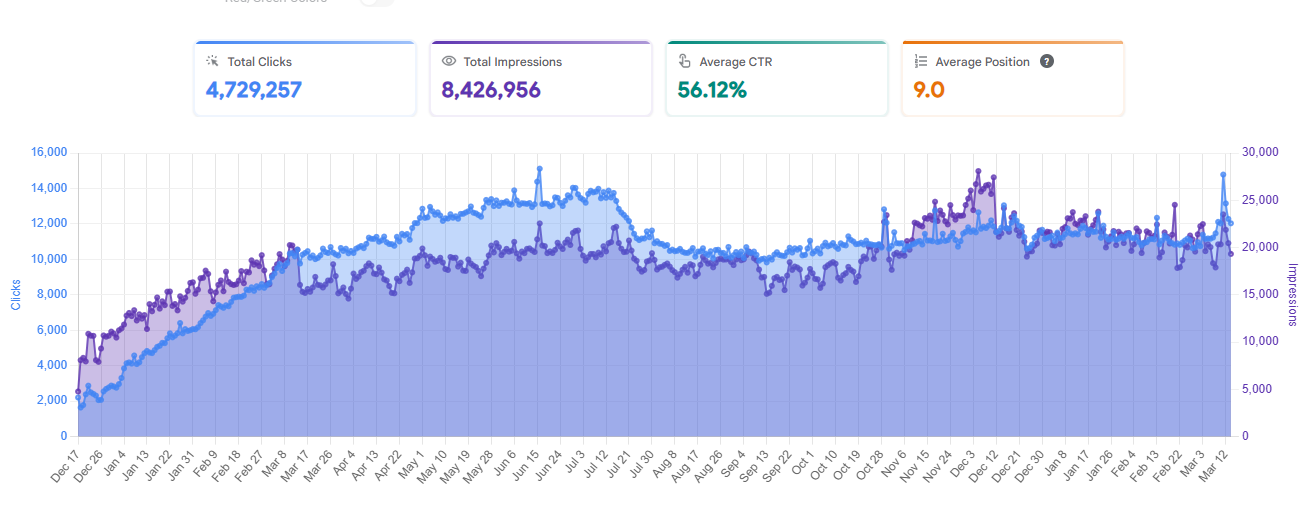
8-month outcomes from organic search alone:
| Metric | Result |
|---|---|
| Organic Impressions | 4.27 million |
| Organic Clicks | 2.52 million |
| New Registrations | 259,000 |
| Paying Users | 80,823 |
| Revenue Attributed to Organic | $3.5 million |
What matters here is the conversion flow: from organic impressions to clicks, from clicks to registrations, from registrations to paying users. Every stage of that funnel was an SEO decision — from the search queries we targeted to the landing pages we built to the UX of the registration flow we informed through CRO recommendations.
What Made This Work
Three things made a difference in this campaign from a standard SEO engagement:
Site architecture first. Most SEO campaigns try to retrofit structure onto an existing site. Building from zero meant the architecture could be designed correctly from day one — no technical debt, no conflicting page structures, and no legacy content to work around.
Search intent rather than chasing volume. Targeting informational and mid-funnel terms first built the brand’s topical authority which also helped commercial terms rank faster. The short-term content was the long-term investment.
Aligned with the product team on SEO best practices. Working alongside developers and the PPC team — not in a silo — meant that SEO decisions were implemented correctly and quickly. No six-week ticket queues. No translation loss between strategy and execution.
Tools Used on This Project
| Tool | Purpose |
|---|---|
| Ahrefs | Keyword research, competitor gap analysis, backlink tracking |
| Google Search Console | Daily performance monitoring, indexation management |
| GA4 + GTM | Conversion tracking, funnel analysis |
| Screaming Frog | Technical audits, crawl analysis |
| Keyword Insights | Keyword clustering and intent classification |
| Surfer SEO | Content briefs and outline production |
| Claude | Content scaling and SEO workflow automation |
| Looker Studio | Executive dashboards and reporting |
| Profound AI | LLM/AEO brand mention monitoring |